Celebrating 10 Years!
If you asked me 20 years ago where I thought I would be now, I would have never in million years guessed that this is what I would be doing. This post is more personal than usual, as I've been reflecting on the journey and thought I'd share some of the reflections with you here, in series of threes.
Ten years ago, on January 29th, 2016, I received my 200 hour yoga teacher certification. My original motive was to get better at yoga since my flexibility was poor and I felt so many of the postures were completely unattainable for me, even after several years of consistent practice. I wasn’t sure how I’d feel about the teaching part, but I figured I'd try it because life on my feet with late night hours in hospitality felt unsustainable.
The 200 hour training was lacking in practically every way – with one exception. One of our assignments was to shadow a class, record it, and then transcribe the recording. I chose Angela Botta who was my absolute favorite teacher at the time. She knew how to make the inaccessible accessible. This assignment was my first introduction to cueing, one of the most valuable tools in a movement related profession. I had no idea these cueing skills would later make people with injuries feel safe in my classes. I had no idea these skills would facilitate my understanding of human movement because if you’re skilled enough at cueing, you can watch how your words land with the people in front of you instead of focusing your attention on demonstrating (the better the teacher, the less you see them demonstrate). I also would never have anticipated the enormous carry over good cueing would have to teaching via Zoom once COVID hit. I learned:
Only say what you need to say. Less is more, don’t add frills.
Have at least 10 different ways to cue the same exact movement. We all respond to words differently.
Break things down to their component parts and then build them back up. This is how brains and bodies learn.
Immediately after I started teaching, I found the author of the anatomy book that we barely skimmed during our training. His name was Leslie Kaminoff, a brilliant story teller and educator with whom I spent the next two years learning from at The Breathing Project in Manhattan. This was my first introduction to anatomy, breathing mechanics, and to three fundamental principles:
The body will always seek to adapt in ways that facilitate its function. It adapts according to our behaviors to continue to survive. This includes bodies in pain, immobility, and injury.
Alignment is mostly a hoax. There is a no right or wrong way to move, sit, stand, perform a posture, or complete an activity.
Our breath is the most fundamental movement pattern.
Around the same time, I started strength training with a trainer for the first time, Vella Stephens, where I quickly encountered these three lessons:
Strength carries over to other things: it markedly improved my yoga practice in a way that countless hours of more yoga did not.
Industries have strong opinions that lack nuance, creating unnecessary misinformation: there was and still is a strong ideological divide between the yoga world and strength training, and between strength training and physical therapy -- not to mention the divides within each industry.
Bodies get injured. It’s normal. I experienced a left knee thing and a right wrist thing. They’ve come and gone over the years but we’re actually still friends to this day.
The decade of my life up until this point was fraught with countless jobs, dabbling interests that never took hold, and undulating depressions from a complete loss of direction. At 30 years old, I had a real thirst for knowledge for the first time in my life. As I was trying to find answers to all my questions related to movement and the body, I found some truly gifted educators – Jules Mitchell, Greg Lehman, Jenn Pilotti, Lorimer Moseley, and Gil Hedley – all who have completely shaped my work. I learned about biomechanics and the behaviors of tissue when we move, the multifaceted nature of pain, the tenets of supportive coaching, and even more about the fine art of cueing. It was around this time that working with injuries and pain became the forefront. People would come up to me after my yoga classes and ask me what was my style of teaching called or if I was a physical therapist. (To this day, clients ask me to describe what I do so they can share it with others – clearly my strength is not branding).
The following 3 years included four weeks in Las Vegas in a 300 hour advanced training in biomechanics and pain; shadowing a movement coach in California trying to absorb what her clients called “magic”; attending three pain seminars with some of the leading pain researchers in neuroscience; and completing a week long cadaver dissection. I was having an identity crisis with what I was doing. I contemplated becoming a physical therapist because yoga was making me feel trapped. Yet, I was struggling to define my role in therapeutics, strength and mobility training, and everything else I was dabbling in. I learned so many things during this time, but I’ll boil it down to three things again:
Nothing is more important in teaching/coaching than meeting someone where they are.
Pain is always multifaceted. There are no exceptions.
There is an infinite number of ways to help someone feel better – there is no one reigning discipline, methodology, or medication for any injury or condition.
Shortly before March 2020, I sought out a movement studio that incorporated some movemet play and improvisation styles I was curious about. Kyle Fincham's classes were like nothing I’d ever experienced. He facilitated game play, grappling, and partner work that so significantly impacted my brain and body it has since permanently changed my movement language. Needless to say, his work and the likes of it are threaded into mine. I learned:
Few things faciliate learning better than play.
Our bodies are powerful tools of communication, but most of us are too disconnected to notice.
Unstructured and non linear movement are the antitheses of our society's current movement behaviors and the keys to unlocking freedom in the body.
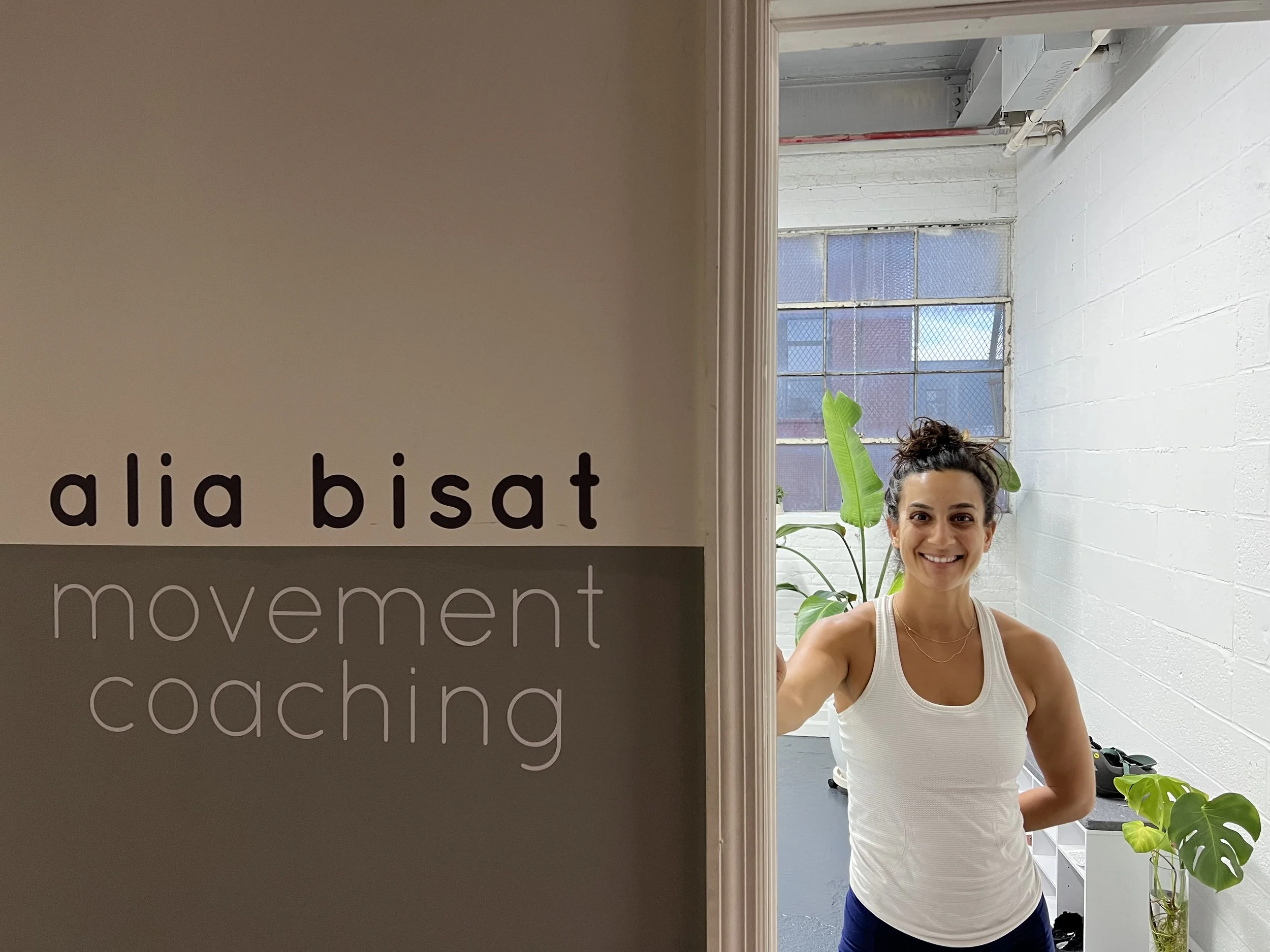
Three months later, COVID finally gave me the perfect “out” to stop teaching yoga and focus solely on the one-on-one work I found deeply rewarding. Mobility, strength, mindful movement, and pain education slowly filtered into focus. Zoom became the way of life for a year before I opened my home for private sessions and then found a studio space in Red Hook. In July 2022, I moved permanently to a studio in Gowanus. I’m so grateful for every single person that’s come through my doors or shown up on my laptop screen. Ten years of working with people continues to teach me:
The key to progress as a practitioner or a client is to loosen our grip on what we think we know to be true. Questioning facilitates growth.
People are difficult and relationships are challenging – and nothing prepares you more for that than the experiences themselves.
Imposter syndrome is normal for those who care. As my father, a physician, once told me, “All good practitioners experience doubt, no matter how many years they have under their belts.” And sometimes, you just say, "I don't know."
Unintentionally, almost exactly ten years later on January 26th 2026, I received my Strength and Conditioning Coach certification from the NSCA – the closest I can get to a relevant certification that didn’t require going back to undergrad. The irony of life is that I refused to touch anything science related while growing up. My mom was a biochemist and my dad was an endocrinologist, and my way of solidifying my individualism was to wipe science off the table from a very young age. Now at 40 years old, I often ponder what things might have been like had I studied science in school giving myself a foundation for easier access to graduate degrees or advanced credentials.
Nonetheless, here I am, with no regrets and humbled to have had so many people trust me enough to cross my path for guidance. Every single student, client, seminar, coach, colleague, (and parents and husband), and experience has contributed to where I am today. I am so grateful for all of it and so excited for the next ten years. Thank you for being here.
Till next time, keep moving.
alia