
What’s a Movement Coach?
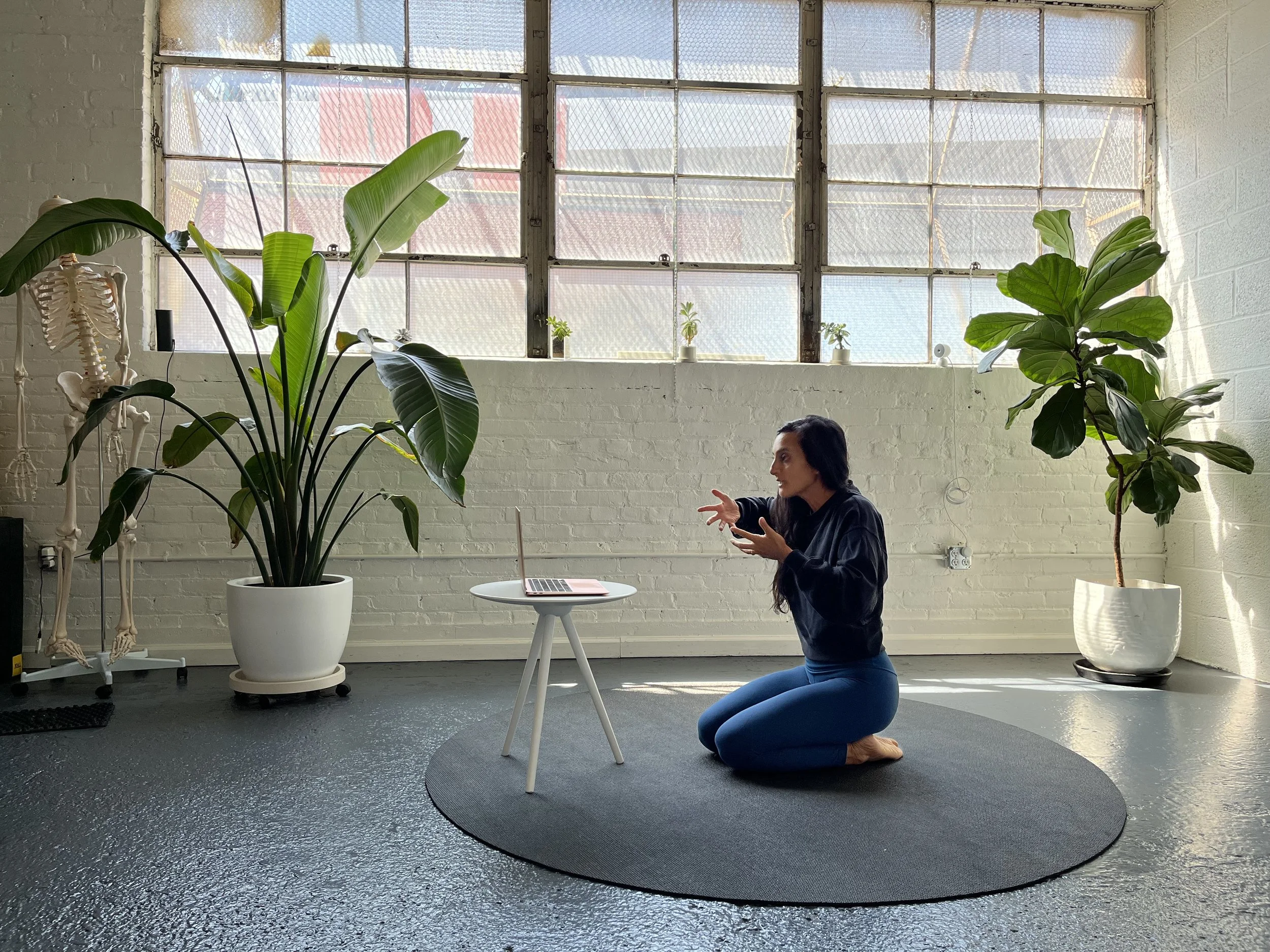
interactive online movement coaching session, I do sessions in person and online.
So what do you do?
I have a bit of social anxiety. My work "title" doesn't help me. I think Movement Coach may be the worst title for what I do, because its as ambiguous as it sounds. It feels impossible to explain in one or two sentences and feel complete because the work encompasses multiple gaps in rehab and fitness based on the person’s needs coming through the door.
This is how conversations usually go in new social contexts:
Other person: “So what do you do?”
Me: “I’m a movement coach.”
Other person: Blank stare.
Me: “I coach strength and mobility for those with chronic pain.”
Other person: “Oh like a physical therapist!”
Me: “Well, there’s rehab work yes, but I’m not a PT.”
Other person: “So what’s the difference between what you do and a PT?”
Me: “Well, people who see me have often done PT but still can’t do the things they want to do very well, so it’s like the next step to getting back to feeling strong, mobile, and functional.”
Other person: “Oh so more like a trainer?”
Me: “Well yes but kind of like a trainer who works with people who are nervous to work with standard trainers because they have some lingering chronic pain or complex systemic issues going on.”
Other person: “Oh yeah I have this [insert any body part] pain that’s been going on for years, do you have any recommendations for that?"
Me, what I want to say: “If it were that simple, you could just use ChatGPT to help you, right?”
Me, what I actually say, “Oh gosh there’s no standard answer. I work within the bio-psycho-social framework which takes the whole person into account when working with pain. We would need to have a full conversation about what’s going on, and I’d need to watch how you move your whole body.A t this point, the other person either says “Wow that must be so rewarding” in which case I feel I’ve succeeded in giving accurate insight into my world; or they say “Oh cool” and mchange topicsbecause they’re mostly still confused the way I will forever be confused when someone tries to explain to me what they do as a product manager.
Sample movement coaching sessions
Since I'm much better at writing by myself than talking in groups of people, I thought I might share a handful of snapshots that reveal what this all actually looks like from person to person. Maybe YOU will have a better way for me to introduce what I do after reading the below?
42 year old woman with one year of chest and neck pain, tightness, and burning with zero structural issues showing up on imaging. All standard treatments have failed her so far and she spiraled into depression coupled with crippling anxiety that kept her from leaving the house by herself and from being able to work.
-Our first several sessions involved talking and somatic sensing. We talked about her home environment, the hardest parts of her days, and how her values around being strong have become unhelpful coping mechanisms.
-I had her watch a few videos and read a book about how pain works like an alarm system and why the brain may alert her with pain even though there’s nothing structurally wrong with her body.
-We began and ended sessions with body scans to reestablish trust with her body by focusing on parts of herself that felt good and strong.
-We included some simple leg strength exercises to build her confidence and some balance games to change her nervous system state from fear to relaxed curiosity.31 year old male with hypersensitivity to body sensations, coming in with neck and shoulder pain, some hand tingling, and terrified of moving his neck. He additionally had low back pain and extreme hamstring tightness.
-Sessions have involve discussing how his anxiety developed watching his father suffer from debiliating chronic pain, how the vertebrae in the spine actually work in contrast with how he believed they worked
-Slow introductions to neck movement that have eventually progressed to weighted neck exericses over the year.
-Gentle lower body mobility progressed to weighted squats and 35lb Jefferson Curls.
-Lately we’ve been peppering in exercises that teach his brain to prefer to rotate his upper body while walking (which it doesn’t currently feel safe doing and contribute to his upper body stiffness).
-He no longer has tingling down his arm or flare ups when he travels, and he’s learned tools to keep his mind from spiraling when he experiences something uncomfortable in his body.99 year old woman who walks with a walker but is mostly seated, with arthritis pain in her hip and knee.
-We stretch because she has a strong preference for yoga from doing it for decades and because she responds very well to deep breathing.
-We do sit to stands with speed, and weighted upper body exercises. Her favorite is twisting punches, which she performs powerfully as she imagines punching our current president . . .
-balancing without her walker while turning her head in various positions
-Lots of games to keep her brain engaged with her body and enhance her neuromuscular coordination.50 year old male, hypermobile, and a laundry list injury history with strong beliefs about how the faulty structure of his body is responsible for his pain. His personality lends to a cycle of “I feel good so let’s go hard — oh shit I did too much and now I’m out for weeks.”
-We pace his progress slowly so that it’s sustainable; strength train in a way that supports his hypermobility; and tailor his love for deep stretching so that it works to support rather than flare his hypermobility symptoms.
-elbow tendinitis rehab exercises -scapular movement education
-Gentle somatic movements to help him stay aware of how he’s holding himself upright, which for him means lots of ribcage movement re-training
-25lb overhead presses, 70lb deadlifts, ring rows, and other traditional strength work.
-Peppered in are conversations and some book reading to encourage him that his body isn’t broken, and that a lof of his flare ups might be triggered by his very stressful work environment.82 year old woman with double knee replacements and chronic low back pain. Our work together began before her knee replacements, and we approached strength and mobility in a way that supported her main goals of hiking and taking several international trips a year.
-After her surgeries, we continued to work on getting down and up off the floor regularly and upper body strength.
-Progressed her post surgery knee rehab way beyond what was offered to her in physical therapy -Addressed secondary surgery related flare ups such ITB syndrome and knee bursitis.
-Lots of mid back mobility exercises slowly building her tolerance to forward bending -- her low back pain is no longer chronic!
-Challenge her vestibular system (she has positional vertigo when turning her head to one side) to improve her balance. She just completed a 32-mile hike in the Smoky mountains with no pain 💪🏼A couple in their 40’s who just want to feel stronger and agile in a holistic way.
-High Intensity Intervals
-Box jumps, deadlifts, squats, single leg get ups, pull ups -Partner games to keep them agile, and engaged with one another. Movement in life is always in relation to someone or something else.
-Sometimes there are sessions spent just sensing how to use myofascial chains to alleviate compression around the hip joint while walking when there’s a back pain flare up.
As you can see, it's a vast landscape with varied terrain, hundreds of trails, even more off shoots, and plenty of ways to re-route and find a different path. However, all paths lead to feeling more comfortable and capable in one's body.
Interested in feeling stronger, more prepared for daily life, and more resilient to chronic pain?
schedule a 20 minute consult
Related Posts:
Celebrating 10 Years!
What is Person Centered Care?