
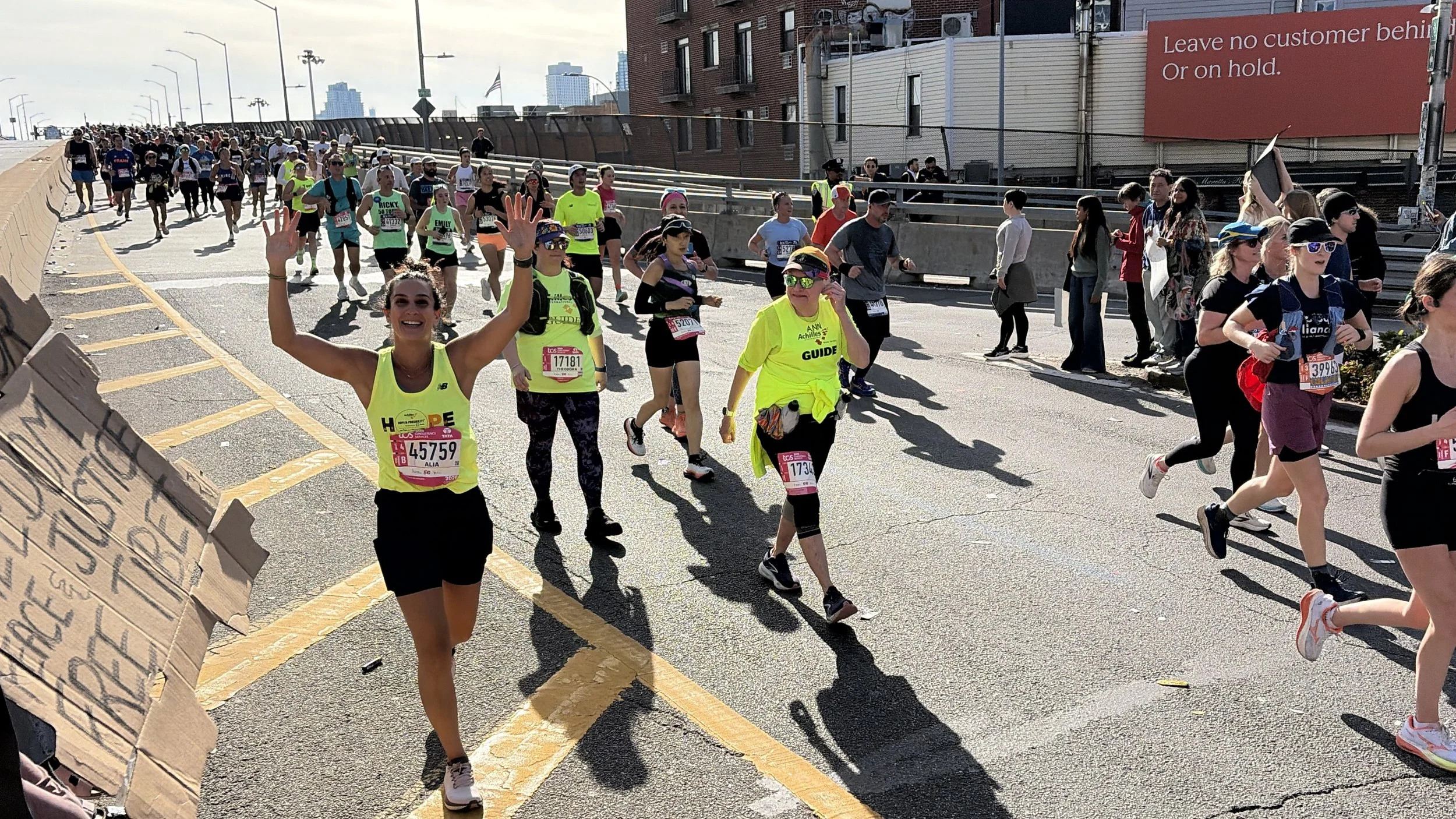
I ran the New York City Marathon 3 weeks ago. Training for it and running it were the hardest things I’ve ever done. One could argue that the sole purpose of running a marathon is to learn how to push through pain. It’s the medium through which you reach your edge — upon which you learn all sorts of things about yourself in a way that isn’t otherwise possible. Why else do millions of spectators come out to cheer the race, tears welling up in their eyes as they watch thousands of people do something most people can’t imagine?
Up until this training, I would shake off little niggles during running, never dramatizing them. I would feel something, keep running to see if it would go away, and if it didn’t, I’d stop to stretch or shake out the area. Almost always, the niggle would disappear. The body is weird, and things show up without explanation, but I find that if we can calmly address them without fear, things often resolve themselves. However, I was not used to pain that doesn’t go away . . . for hours.
Pain vs. Suffering
For reasons I couldn’t figure out, my training felt particularly difficult relative to experiences of others I was talking to or reading about. Physically, my body felt like it was breaking down with every run longer than fourteen miles even though I was fueling, sleeping, and progressing meticulously. Psychologically, there were things going on in my personal life that made this pain feel like suffering every single time. I wrote about pain versus suffering earlier this year and how our stories around our pain create a meaning that we attach to it. Often, it’s the meaning more than the physical pain that makes the experience feel so intolerable. I felt like my runs were fights. I was fighting the demons of my life with every step I took, and the body aches that felt like demons wanting me to fail often brought me to tears. I didn’t fully comprehend this layer of suffering until one run in early October. I ran 20 miles, and even though it was really hard, I didn’t suffer. My body ached and begged me to stop just like all the other runs, but I wasn’t miserable. I finished the run physically exhausted and aching but mentally unweighted. I was stunned at how different it felt, and that’s when I understood how much meaning I had been attaching to the pain.
Pushing through pain
I wish I could say whatever was different on that day carried over to the race, but it didn’t. Marathon day was incredibly painful. While I felt great at first, my body began to ache about two hours in and progressively got worse over three more hours. I had never pushed through that much pain before. I crossed the finish line with nothing physically or emotionally left to celebrate what I’d just accomplished. I’m not sharing this with you to garner pity. It was an incredible day and experience, and I gushed about it on IG the next day after some healing and perspective. I’m sharing this with you so you understand some context — because when I found out about the girl who died, my head spun out.
Rachel Apa was 24 years old. She was a healthy, fit, Division 1 field hockey player who trained extensively for her first marathon. She collapsed at mile 23 and later died in the hospital. Rachel felt great early on in the race, as did I. She started feeling pain enough to text her dad about it at mile 18, around the same time in the race my pain was forcing me to take walk breaks. She texted her dad again a few miles later “Ow, ow ow” around the same time I texted my husband and sister, “I might just die right here on 171st Street.” She died from a condition in which muscle fibers break down so extensively that they release their proteins into the bloodstream, which is toxic. While rhabdomyolysis can normally be treated, she didn’t survive. I dove headfirst into a very deep rabbit hole to learn what I could. Could this have been me? There were so many comments online and some statements made by doctors about the incident that said something like, “Runners should listen to their bodies.” What?? To train for a marathon is to learn NOT to listen to your body. If we listened to our bodies, we would stop running after the first mile.
I spend my days coaching people how to navigate pain. I find the concepts of pain threshold versus pain tolerance fascinating (I wrote about it here), and I’ve long been curious about how professional athletes process pain. Needless to say, Rachel’s death had me half freaking out, and half brimming with questions that will never be answered. How bad was her pain? What did running the marathon mean to her? Did she have a genetic disposition? Had she trained in this much pain before? Did being an athlete have an effect on how her brain made sense of the pain?
This year’s New York Marathon was the largest marathon in history with 61,529 runners. Only 99 of those runners were professionals. That means 61,430 were amateur runners, with a third of them running their first ever marathon. Only 383 runners didn’t finish. Only one person died. The numbers indicate that what happened to Rachel Apa was a rare, tragic incident. And yet, I can’t help but reflect on how we’re all assessing the risks of pushing through pain all the time.
Resiliency (Carter)
Carter came in for a session and was feeling pretty good. After a set of chin-ups, he started feeling pain in his elbow. He wasn’t sure whether or not to keep going. We discussed the guidelines to make this decision. Step one was to make sure it wasn’t above five on the pain scale (it wasn’t) and that it wasn’t getting worse with more reps (it wasn’t). Step two was to take into account the context of his life (stress/sleep/past experiences, etc). Step three was to confirm that it’s probably fine to continue, but we’ll have to “wait and see” what happens after 24-48 hours. The casual nature with which I suggest this paired with how ambiguous the actual advice is always leaves people to look at me with a face that says, “Wait, really? That’s the best thing I can do?” Yes. That’s the best you can do. We are our own experiments, and there’s not a single person (I don’t care how many letters they have behind their name) who can tell you with 100% certainty that you will or will not have a flare-up. You just have to wait and see.
From having this conversation over and over again, I’ve found there are two things that dictate which way the person goes, whether they choose:
Option A: to take the risk with “continue activity with pain and wait and see” or
Option B: play it safe with “I’m going to stop and not take the risk.”
The first is one’s sense of resiliency. Whether or not we choose to take the risk to push the boundaries of our pain depends on how resilient we believe we are, in general, and in that very moment. This belief is shaped by our past experiences and the current context. Resiliency (bouncing back after setbacks) has a relationship with agency (the capacity and willingness to make intentional choices and shape your life), and agency shows up in the research as a factor that influences pain — the more agency you have, the less pain you’re likely to have and the more quickly you may recover. Less pain and quick recovery, in turn, positively impact one’s assessment of their own resiliency. I explained this to Carter, and he decided to keep going.
What your pain means to you (Molly)
The second thing that dictates the risk someone is willing to take depends on what the pain means to them.
Molly was one hour into her two-hour weekly group tennis lesson when she twisted her ankle. After 10 minutes of sitting, stretching, and assessing, she couldn’t decide whether or not to keep playng. Her pain level was five, she felt pain when she jumped, but she felt fine when she walked.
I asked her, “Why not just go home? It’s only an hour of tennis, you’ll be back next week, maybe better not to risk compensating your movement while you play.”
She looked at me unconvinced. Anguished with indecision, she said “Why is this so hard?”
“It seems like this incident means something to you. What’s really going on?” I asked.
Immediately, she knew. “I’m at 140% in my life right now and I don’t want to admit that I can’t do it.”
Molly picked up an extra job as a Whole Foods cashier to make ends meet for her family, and the hours on her feet were taxing her body and affecting the one thing she did every week that she found so much joy in. This was a big deal. Of course she didn’t want to go home. Taking the risk of further injury was worth it because she wanted to prove that things weren’t going to fall apart.
A normal human making a everyday decision (Rachel Apa)
There are awful people on the internet that blame Rachel for pushing past her pain even though what Rachel did was what more than 60,000 other runners did that day. She took the risk to keep going, as the risk probably meant something important to her. And she took the risk to keep going believing, based on a host of past experience and context, that her body was resilient enough to recover. She had no way of knowing that for whatever reason, on that day, it wasn’t.
I realize this is a particularly heavy piece, and I don’t have anything to tie it all together. Thank you for allowing me to share my experience and what’s been mulling around in my head as a result. I’m constantly reminded that pain is so complex, and we as humans operate in ways we still don’t fully understand. I cope with the uncertainty by having a profound sense of awe and respect for the human body. Maybe you do too.
Keep moving.
Related Reading:
Three Guidelines When Moving with Pain Feels Scary
Pain vs. Suffering
Pain Threshold vs Pain Tolerance